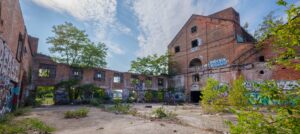
BY Steven Litt PUBLISHED June 30, 2026. See Article.
The city of Cleveland and the nonprofit Site Readiness for Good Jobs Fund on Tuesday announced the first big deal for the Midline, an effort aimed at reviving manufacturing across parts of the East Side pockmarked by brownfields and long-vacant factories.
MMY US, based in Louisville, Ky. as the American-owned affiliate of London-based MMY Global, will repurpose the long-disused Wellman-Seaver-Morgan factory at 7000 Central Avenue as a production site for modular, steel-framed housing.
A special twist of the deal is that components made at the factory, in the Central neighborhood, could help Cleveland rebuild Central and other neighborhoods harmed by redlining, disinvestment and housing demolition, said Brad Whitehead, inaugural managing director of the site fund.
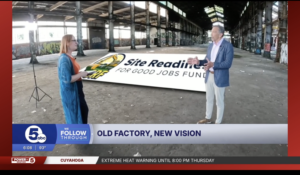
He and Robin Bartram-Brown, the CEO of MMY U.S. and of MMY Global, spoke to Ideastream Public Media on Monday, a day ahead of Tuesday’s announcement.
The event was planned for noon Tuesday at the Wellman-Seaver building. Cleveland Mayor Justin Bibb and Ward 5 Councilman Richard Starr were scheduled to speak.
“I am over the moon about this,” Whitehead said of the MMY deal. “It’s just so beautiful. If somebody lives in this neighborhood, they could literally get a job building a house that they will live in.’’
A $2.56 million package of Ohio historic preservation tax credits for Wellman-Seaver, announced by the city and the site fund last week, triggered Tuesday’s announcement. The tax credits will support a renovation estimated to cost nearly $26 million.

The renovated factory will open within approximately two years and will employ roughly 150 workers, Whitehead said. MMY US will use large, newly installed machines to bend, cut and punch sheets of steel to form studs as the basic component of modular housing units, Bartram-Brown said.
The studs will be assembled on site to create modules for workforce and affordable single-family and multifamily housing.
Housing revolution
Modular housing can be built faster and with greater predictability and quality control than traditional housing made with wood studs, Bartram-Brown said. Cleveland has sought to encourage more modular housing as a way to rebuild depopulated city neighborhoods.
“We’re absolutely delighted,’’ Bartram-Brown said of his firm’s deal in Cleveland. “We’re really excited that this is going to open up the potential of Canada for us across the water, using the Cleveland port. There’s a lot of exciting things happening around this investment. So yeah, we just want to get started now.’’
MMY U.S. announced plans for its first U.S. plant in Louisville, Ky., in 2024. It now has 10 projects underway in the U.S., including in Kentucky, Indiana and Cleveland, Bartram-Brown said.
As a sample of what’s to come here, the company is putting the finishing touches on a single-family house for the nonprofit Habitat for Humanity on a Cuyahoga County Land Bank lot at 1803 Brainard Ave. on Cleveland’s West Side. The project took eight weeks to bring near completion, he said.
In Cleveland, MMY housing could help rebuild portions of the city including a Housing Innovation District proposed for the city’s East Side near the Wellman-Seaver factory, Whithead said.
Big objectives
The city announced the formation of the Site Readiness Fund in 2023 and devoted $50 million in federal dollars from ARPA, the American Rescue Plan Act of 2021. In 2024, City Council turned over the fund’s assets to the Cleveland Foundation for management.
The fund has since grown to $83 million, including $10 million from the Cleveland Foundation and another $10 million from the family of early 20th-century engineer Samuel T. Wellman, a namesake of the Wellman-Seaver factory. The fund has a goal of reaching $100 million.

The nonprofit led by Whitehead receives its funding from the Wellman Fund at the Cleveland Foundation. The joint goals of the nonprofit and the foundation fund are to assemble and clean some 4,000 acres of disused industrial properties across Cleveland. The idea is to make them competitive with suburban sites that have contributed to job sprawl across the region.
A related goal is to solve the “spatial mismatch’’ affecting job seekers in Cleveland who need to be able to afford a car to drive to far-off work sites. Owning a car costs on average more than $12,000 a year, according to the American Automobile Association, a possible barrier to employment for struggling families.
Reusing polluted and underused industrial land in Cleveland will bring jobs closer to city residents who need them, Whitehead and other community leaders have said.
The Midline’s beachhead
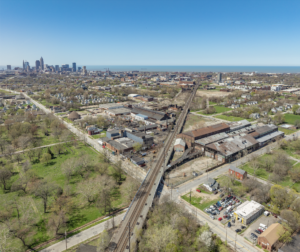
In May, the city and the Site Readiness Fund launched the Midline as a focused effort to assemble, clean and repurpose 350 acres of brownfields and vacant factories in the Central and Fairfax neighborhoods.
The initiative aims to create at least 1.5 million square feet of industrial and commercial space across 350 acres that would generate roughly 2,500 direct jobs within walking distance or a transit ride. The Midline over time could contribute $100 million in tax revenue for the city annually, advocates said.
The Midline zone extends about 1.5 miles from Euclid Avenue at East 55th Street southeast to Opportunity Corridor, a 400-acre area linking the Cleveland Clinic to the Slavic Village neighborhood.
A greenway connecting the Midline to surrounding neighborhoods and the Cleveland lakefront is part of the project.
Reviving a behemoth
The Wellman-Seaver factory has functioned as a symbolic beachhead for the Site Readiness Fund. The fund spent $845,000 in 2024 to acquire the 183,000-square-foot factory as its first major investment, even before conceiving the Midline.
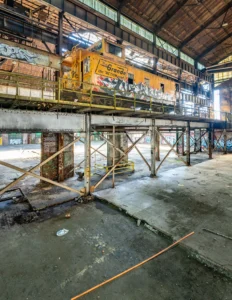
Built in 1901 just southeast of Euclid Avenue at East 55th Street, the factory once produced Hulett ore unloaders, the giant cranes with a graceful dip-and-grab motion that transferred coal, ore and other bulk cargo to rail cars across the Great Lakes for decades in the 20th century.
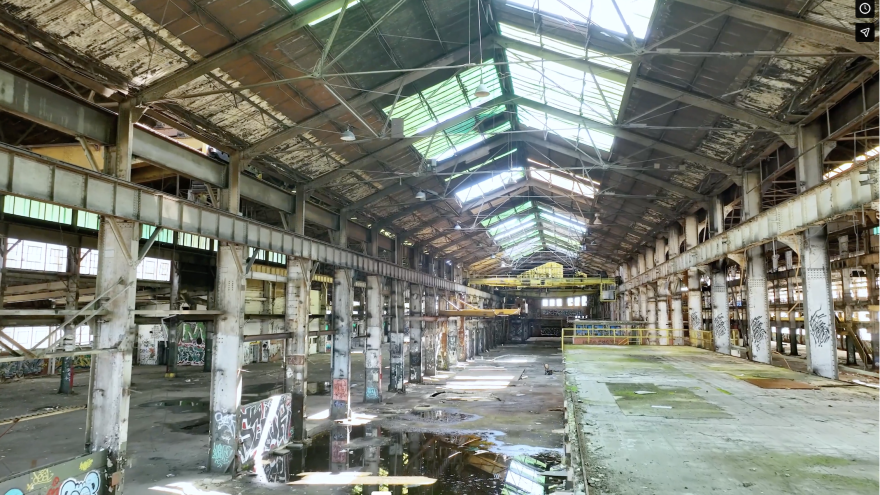
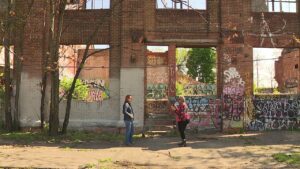
The factory became largely inactive starting in the 1970s and has been all but vacant since the 1990s. Its structure is in good shape, Whitehead said, and there’s little pollution on the site. The renovation will include a new roof, windows and siding, and repairing water damage. Reviving the building serves numerous purposes.
“It’s addressing the housing crisis,’’ Whitehead said. “It’s bringing employment to these neighborhoods. It’s fixing an eyesore in the city. And it’s recreating an iconic structure.’’
The deal will be structured as a partnership involving the Site Readiness Fund and MMY as partners in a holding company that will lease the building to MMY.
The deal has not been finalized, Whitehead and Bartram-Brown said. Sign-off depends on receiving customary incentives from the state of Ohio and the federal government, including New Markets Tax Credits. Community benefits will also be agreed upon with the city of Cleveland. Both Whitehead and Bartram-Brown said they’re confident the deal will be finalized. They see no obstacles.
“We’re committed to delivering the project,’’ Bartram-Brown said. “I believe, as Brad does, that we’re very close to that happening now.”